
Emergency Plumber Charlotte Ceiling Leak: What to Do When Water Comes Through the Ceiling
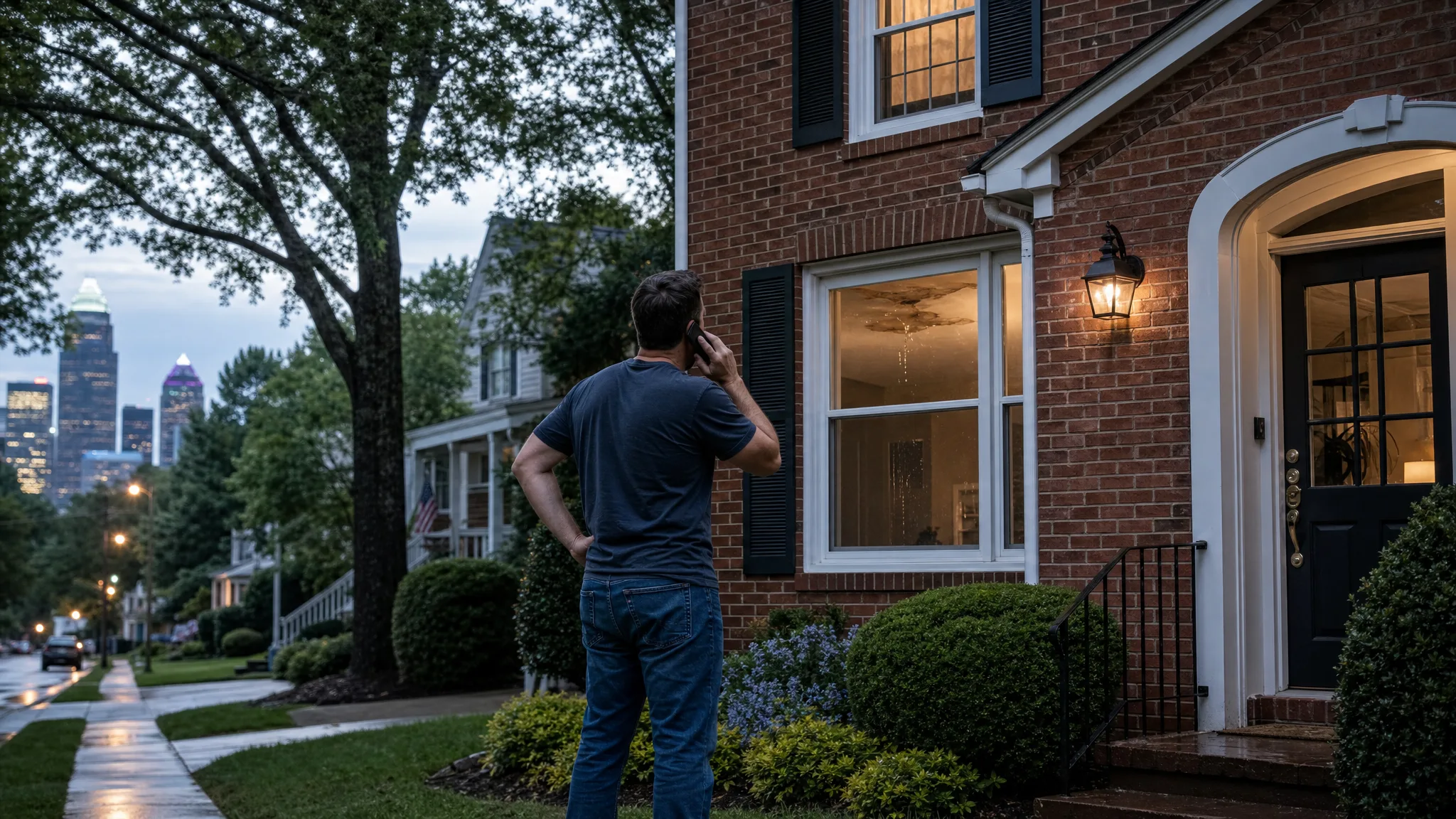
Water dripping, staining, or bulging through a ceiling is a situation to take seriously. The visible ceiling damage may be below the actual problem: a leaking supply line, an overflowing bathroom fixture, a failed water heater connection, or a drain backup from an upstairs room. In some Charlotte homes, the source may instead be HVAC condensation or a roof leak after rain.
The immediate goal is not to diagnose every detail yourself. It is to keep people away from electrical hazards, limit additional water flow when practical, protect the area below, and arrange qualified help when an active plumbing failure is likely. This guide provides a calm decision path for a ceiling water leak emergency in Charlotte.
Water Through the Ceiling: Treat Safety and Containment as the First Priority
A ceiling can hold a surprising amount of water before it begins dripping. A growing stain, sagging drywall, peeling paint, or a rounded “bubble” in the ceiling means water may be pooling above the finished surface. That material can weaken and fall without much warning.
First, move people, pets, furniture, electronics, and valuables out of the affected area. Do not stand directly beneath a bulging section of ceiling, and do not climb a ladder to press, puncture, or inspect it from close range. The ceiling may be unstable, and water may travel well beyond the point where it becomes visible.
If Water Is Near Lights, Outlets, or Electrical Equipment
Water and electricity are the most urgent combination in a ceiling leak. If water is dripping from or pooling around a ceiling light, fan, smoke detector, outlet, electrical panel, or nearby wiring:
- Keep everyone away from the wet area and do not touch the fixture, switch, outlet, or wet ceiling surface.
- Do not attempt to remove a light cover or ceiling fan canopy to “check” the leak.
- If you can safely reach your electrical panel without entering a wet area, turn off power to the affected room or circuit. If that cannot be done safely, leave it alone and contact an electrician or emergency services as appropriate.
- Do not use extension cords, fans, shop vacuums, or appliances around standing water until electrical safety has been addressed.
The Electrical Safety Foundation International provides general guidance on avoiding electrical equipment that has been exposed to water. In a home with an active ceiling leak, it is better to stay clear of questionable fixtures than to take a risk trying to preserve power to the room.
Contain What You Can Without Creating a New Hazard
If the area is safe and the ceiling is not severely sagging, place buckets, bins, or waterproof containers under steady drips. Put towels around the containers to catch splashback. Move rugs and small furnishings first, then larger items if they can be moved without passing under the damaged ceiling.
A small, isolated drip may seem manageable, but a water-stained ceiling can conceal wet insulation, framing, wiring, and drywall. Take clear photos or a short video from a safe distance for the plumber. Note whether the drip is steady, intermittent, or gets worse when someone runs water upstairs.
If you are a landlord or property manager, ask the occupant to stop using the bathroom, kitchen, laundry equipment, or other plumbing fixtures directly above the leak until the source is identified. A good first report includes the apartment or room number, the affected ceiling location, whether water is still actively flowing, and any fixture that was recently in use.
When to Shut Off the Main Water Supply Immediately
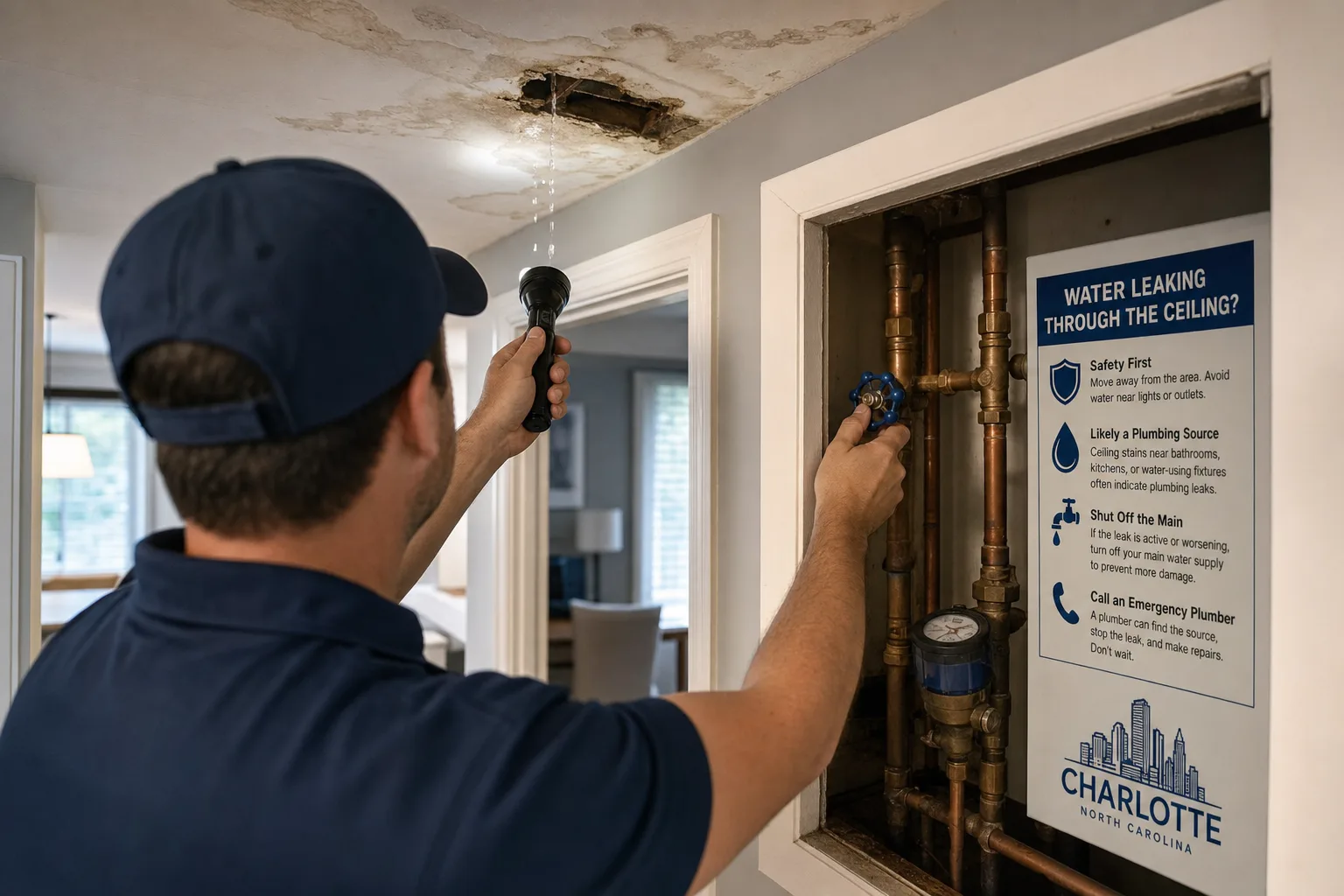
You do not need to shut off the main water valve for every old ceiling stain. However, shutting off the water supply is often the right protective step when there is an active or worsening plumbing leak and you cannot isolate it at a closer valve.
Turn off the main water supply immediately when any of the following applies:
- Water is actively dripping, streaming, or spreading through the ceiling.
- A ceiling bulge is growing or a large amount of water appears trapped overhead.
- You suspect a broken supply line, pipe fitting, water heater connection, or appliance hose.
- Water flow continues even after everyone stops using fixtures in the home.
- You cannot tell which upstairs fixture is feeding the leak.
- Water is reaching a light fixture, outlet, electrical panel, or another electrical area.
- The leak is affecting a lower floor, shared building area, neighboring unit, or valuable property.
Shutting off the main can stop fresh water from feeding a pressurized plumbing leak. It may not stop water already stored in the ceiling cavity, and it will not correct a roof leak, a condensate issue, or a drainage problem already holding water. Still, when a burst pipe ceiling leak or pressurized line failure is possible, stopping the supply can greatly limit additional damage.
How to Locate and Shut Off the Main Water Valve
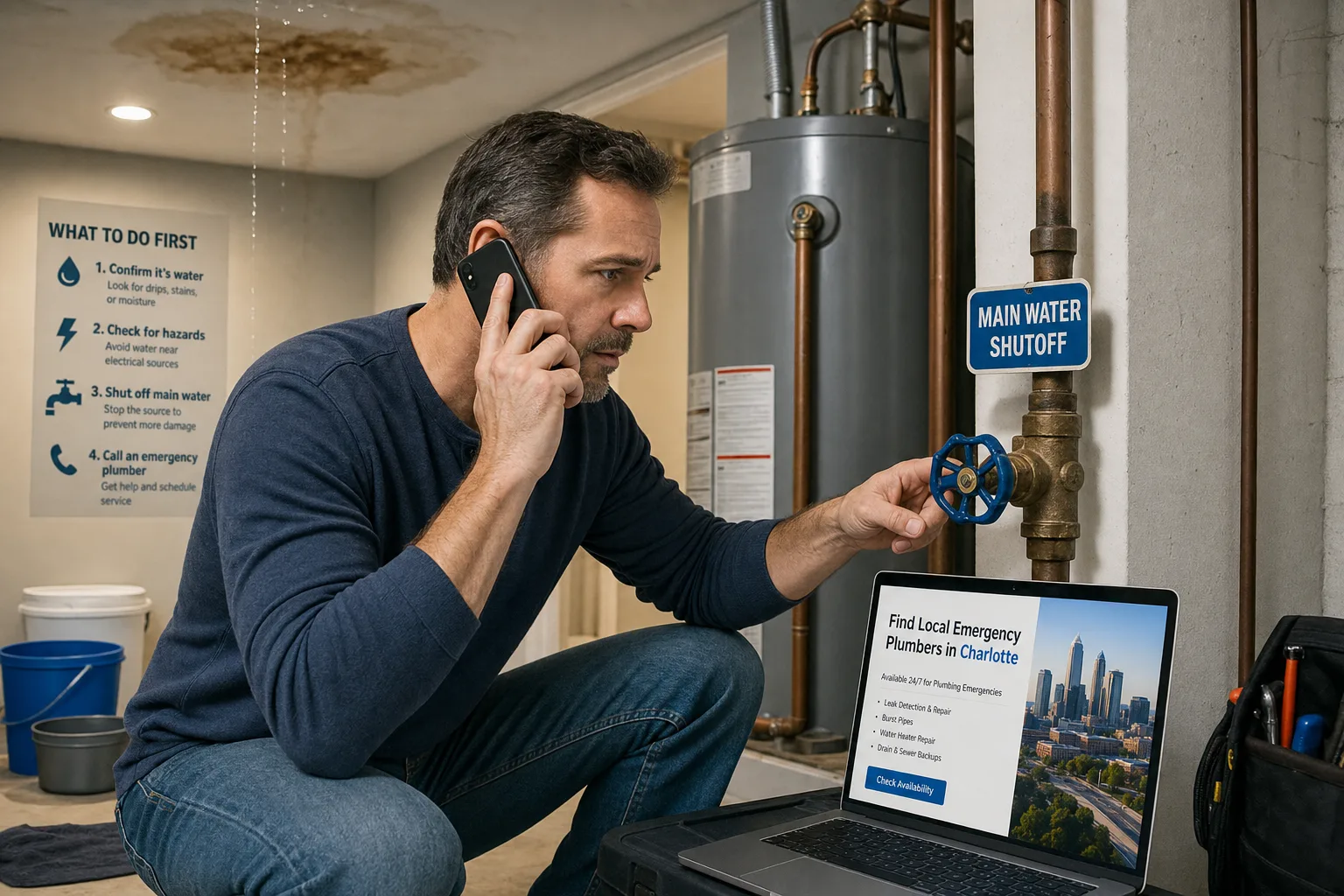
In Charlotte-area houses, the main shutoff is often located where the water line enters the home. Look in practical service areas such as a basement, crawlspace access area, utility room, garage, mechanical closet, or near the water heater. The valve may also be near an exterior wall on the side facing the street, though layouts vary by property.
Look for the main cold-water line and a valve with either a round wheel handle or a straight lever. A lever-style ball valve is generally closed when the handle sits perpendicular to the pipe. A wheel-style valve is typically closed by turning it clockwise. Do not force a corroded, seized, or damaged valve. If it will not move with reasonable hand pressure, stop and tell the plumber.
After shutting off the main, open a cold-water faucet at a lower level of the home to relieve some remaining pressure and confirm that the supply has stopped. Do not run water unnecessarily if you are unsure of the source or if drainage is also a concern.
For a condominium, apartment, or other multi-unit property, your unit may have an individual shutoff, or the building may control the main. Contact the property manager, maintenance line, or building emergency contact promptly. Do not close a building-wide valve unless you are authorized and know it serves your unit.
If you are unsure whether the main needs to be shut off, review this fuller guide on what to do during a plumbing emergency in Charlotte. An active, unexplained ceiling leak is generally a stronger reason to isolate water than a dry, old stain with no current moisture.
How to Tell Whether the Leak May Be Plumbing, HVAC, or a Roof Issue
Water shows up at the weakest point in the ceiling, not necessarily directly below the source. A plumbing problem is common when there is a bathroom, kitchen, laundry area, water heater, or plumbing pipe route above the affected room. But it is important not to assume every ceiling stain is a pipe leak.
Signs the Source May Be Plumbing
A plumbing source is more likely when the leak changes in response to water use. For example, water may begin or worsen after someone showers, flushes a toilet, runs a washing machine, uses a dishwasher, or turns on a sink.
Common plumbing-related causes upstairs include:
- Overflowing fixtures: A toilet, tub, shower, or sink may have overflowed, allowing water to travel through the floor assembly.
- Leaking supply lines: A pressurized hot- or cold-water line, shutoff valve, appliance hose, or fixture connection can leak continuously, even when no one is using a fixture.
- Drain or waste-pipe leaks: A loose drain fitting, damaged pipe, failed seal, or backup may leak only while water is draining.
- Water heater problems: A leaking tank, temperature-and-pressure relief discharge, supply connection, drain valve, or nearby piping can send water into an adjoining ceiling area.
- Drain backup: Wastewater backing up at an upstairs tub, shower, or toilet requires urgent caution. Avoid contact with the water and stop using related fixtures.
Water that is warm may point toward a hot-water line or water heater issue, but temperature alone is not a reliable diagnosis. Likewise, clear water can still come from a plumbing failure; color and odor may offer clues, but they do not make the area safe to inspect closely.
Signs the Source May Be HVAC Condensation
HVAC-related moisture can appear near air handlers, ductwork, ceiling registers, or cooling equipment. A clogged condensate drain, disconnected drain line, or drain-pan issue may cause intermittent dripping when the air conditioner is operating. In Charlotte’s humid weather, condensate systems can produce enough water to make a problem noticeable.
If the leak occurs near HVAC equipment or appears primarily while the cooling system runs, tell the responding professional. Still, do not assume it is harmless condensation if water is increasing, electrical fixtures are involved, or you cannot safely inspect the area.
Signs the Source May Be a Roof or Exterior-Water Problem
A roof leak is more likely when the stain or dripping starts during or soon after rain, especially near an exterior wall, chimney, skylight, attic area, or roofline. Wind-driven rain can also make a roof problem show up in a location that is not directly beneath the damaged roofing material.
If no plumbing has been used, the main water is off, and water continues to appear only during wet weather, a roof source deserves consideration. A plumber may still help rule out accessible plumbing, but roof repair may require a separate contractor.
When the source is unclear, do not delay based on guesswork. The urgent question is whether water is active, spreading, unsafe, or damaging the building—not whether you can identify the exact pipe or component yourself.
What to Do While Waiting for an Emergency Plumber in Charlotte
After protecting the area and isolating water if needed, prepare useful information for the emergency plumber. This can make the first visit more efficient and help the technician arrive ready to investigate the likely source.
Information to Have Ready for Faster Dispatch
- The Charlotte neighborhood or property location and whether it is a house, townhome, condo, apartment, or rental property.
- Whether water is actively dripping, whether the ceiling is bulging, and whether the flow is getting worse.
- Whether the main water supply has been shut off and whether it stopped or reduced the leak.
- The room below the leak and what room, fixture, appliance, or water heater is above it.
- Whether anyone recently showered, flushed, used a washing machine, ran a dishwasher, or noticed a toilet overflow.
- Whether water is near a light, ceiling fan, outlet, electrical panel, or other electrical component.
- Whether the water appears clean, cloudy, rusty, or potentially contaminated by a drain or sewer backup.
- Photos and videos taken from a safe distance, along with the approximate time the leak was first noticed.
Do not keep testing the suspected upstairs fixture to confirm the leak. Repeated flushing, showering, or running faucets can add water to a hidden failure. If you suspect a fixture-specific problem and it has a local shutoff valve you can safely access, close that valve. Otherwise, leave the water off at the main until the plumber assesses the situation.
When safe to do so, leave clear access to the affected rooms, the water shutoff, the water heater, and any upstairs plumbing area that may be involved. Secure pets and keep children away from buckets, wet floors, and the damaged ceiling.
What an Emergency Plumber Will Check and Repair
An emergency plumber’s first job is usually to find and stop the water source. The visible ceiling stain is evidence, but it is not always the leak location. A technician may inspect the room above, accessible plumbing lines, fixture connections, water heater components, drains, and the surrounding area to narrow down the cause.
Depending on the symptoms, an emergency plumbing visit may involve:
- Checking water pressure and visible supply-line connections.
- Inspecting toilets, tubs, showers, sinks, appliances, and shutoff valves above the affected ceiling.
- Testing drain operation carefully after the area is made safe.
- Examining water heater connections, valves, and the tank area.
- Locating accessible pipe leaks or failed fittings.
- Repairing or replacing a damaged pipe section, valve, supply connector, drain component, or fixture-related part where accessible.
- Recommending further access work, leak detection, HVAC service, roofing evaluation, or restoration support when the source is outside the immediate plumbing repair scope.
A plumber may need to open a limited area of drywall or ceiling to reach a concealed pipe or confirm the water path. That is different from repairing, texturing, painting, and drying the entire ceiling afterward.
Leak Repair and Water-Damage Restoration Are Often Separate Services
Stopping the plumbing leak is essential, but it does not automatically dry wet drywall, insulation, framing, flooring, or cabinetry. Water mitigation and ceiling restoration can be separate services. Depending on how much water was involved and how long materials stayed wet, you may need a restoration professional to assess drying, removal of damaged materials, and moisture control.
Ask the plumber what was repaired, what areas may still be wet, whether water use can resume, and whether they observed conditions that warrant restoration, electrical, HVAC, or roofing follow-up. Prompt drying after the leak is stopped helps reduce the chance of ongoing material damage.
For a broader overview of the visit itself, read what to expect from emergency plumbing service. The practical process applies whether the emergency is a leaking ceiling, failed connection, drain problem, or water heater issue.
Common Mistakes That Make Ceiling Water Damage Worse
In a stressful moment, it is easy to focus on the ceiling stain and overlook the source. Avoid these common mistakes:
- Ignoring a growing stain or bulge: Waiting can allow additional water to saturate drywall, insulation, and adjacent rooms.
- Standing under a sagging ceiling: Wet ceiling material can fall, sometimes along with wet insulation or debris.
- Touching wet fixtures or using electrical equipment nearby: Water near lights, outlets, panels, and wiring is a safety issue, not a cleanup inconvenience.
- Running upstairs fixtures “one more time” to test the leak: This can turn a limited leak into a larger water event.
- Forcing the main shutoff valve: A weakened valve can break or begin leaking. If it is stuck, stop forcing it and report the issue.
- Assuming the ceiling location identifies the source: Water can travel along pipes, joists, and framing before appearing below.
- Trying to patch, caulk, or paint over the ceiling before the source is fixed: Surface repairs can hide conditions that still need drying and evaluation.
- Waiting until business hours despite active water: A leak that is spreading, affecting electrical components, or impossible to isolate calls for emergency attention.
How to Compare Emergency Plumbers in Charlotte for a Ceiling Leak
When searching for an emergency plumber Charlotte ceiling leak, look beyond a generic “24-hour” label. You want a provider who understands that the immediate priority is source control, safe assessment, and a clear explanation of what happens after the plumbing repair.
As you compare local options, ask practical questions:
- Do they handle active interior leaks, ceiling leaks, water heater leaks, drain backups, and supply-line failures?
- Can they assess the likely source above the affected ceiling and explain what they can repair during the visit?
- What should you do before they arrive: shut off the main, stop using a specific fixture, or keep clear of an electrical area?
- Will they explain any access work that may be needed to reach concealed plumbing?
- Can they clarify whether the problem appears plumbing-related or whether HVAC, roofing, electrical, or restoration follow-up may also be needed?
- Can you verify that the contractor is properly licensed for the work in North Carolina through the state plumbing contractor licensing resources?
The final repair cost can depend on what is leaking, how accessible the pipe or connection is, whether the issue is a supply line or drain, the condition of surrounding materials, and whether additional services are needed after the plumbing source is stopped. A reliable diagnosis comes before anyone can responsibly define the complete repair scope.
PlumberHacks can help you find a plumber in Charlotte when you need to compare local emergency plumbing options for an active leak, suspected water heater problem, or ceiling water damage caused by plumbing.
Frequently Asked Questions About Ceiling Leaks in Charlotte
Should I shut off the main water if water is leaking through my ceiling in Charlotte?
Shut off the main when water is active, spreading, or likely connected to a pressurized plumbing leak, especially if you cannot isolate the problem at a nearby fixture valve. It is also a sensible protective step when the source is unclear and water is reaching electrical areas or lower floors. A dry, old stain with no current moisture does not automatically require shutting off water, but it should still be investigated.
What should I do if ceiling water is near a light fixture, outlet, or breaker panel?
Keep away from the affected area and do not touch the fixture, switch, outlet, ceiling fan, or wet ceiling. If you can safely reach the electrical panel without walking through wet conditions, turn off power to the affected circuit or room. If there is any doubt about safety, do not attempt it; arrange professional electrical and plumbing help as needed.
Can a ceiling leak wait until morning, or do I need an emergency plumber tonight?
An active leak generally should not wait if water is still flowing, the stain or ceiling bulge is growing, the source cannot be isolated, there is suspected wastewater, or electrical components are affected. If the leak has fully stopped, the ceiling is stable, water is shut off or the fixture is isolated, and no electrical hazard is present, you may be able to schedule urgent next-day service. When uncertain, treat ongoing water as an emergency plumbing issue.
Will an emergency plumber repair the ceiling too, or only stop the plumbing leak?
An emergency plumber typically focuses on locating and repairing the plumbing source. They may need to open a small area to access a pipe, but drying, drywall replacement, insulation removal, painting, and broader water-damage restoration may require separate professionals. Ask for a clear explanation of the repair completed and what follow-up is recommended.
What affects the cost of an emergency ceiling-leak plumbing repair in Charlotte?
The scope depends on the source of the leak, how easy it is to access, the needed parts and repairs, the time required to diagnose a concealed failure, and whether there is a related drain, water heater, fixture, or supply-line issue. Restoration, electrical work, HVAC service, and ceiling repairs may be separate from the plumbing repair. Request an estimate or explanation of the expected repair scope once the source is identified.
Get the Leak Diagnosed Before the Damage Spreads
Water through a ceiling is not a problem to solve by watching the stain. Protect the area, avoid electrical hazards, shut off the main water when an active plumbing failure is likely or cannot be isolated, and stop using fixtures that may be feeding the leak.
If the leak is active, spreading, or difficult to isolate, compare available Charlotte emergency plumbers and request fast diagnostic help before water damages ceilings, insulation, electrical components, or lower floors.


